
✨ Save 50% on Annual Plans ✨ Claim 6 months FREE →
Generate Your Own Snow White Synth Rebellion Art
Create your own rebellious Snow White images! It's free, easy, and endlessly creative with our AI generator.
a year ago
Snow White Leads Synth Rebellion
Created a year ago · 2 comments· 0 likes
 Flux
Flux
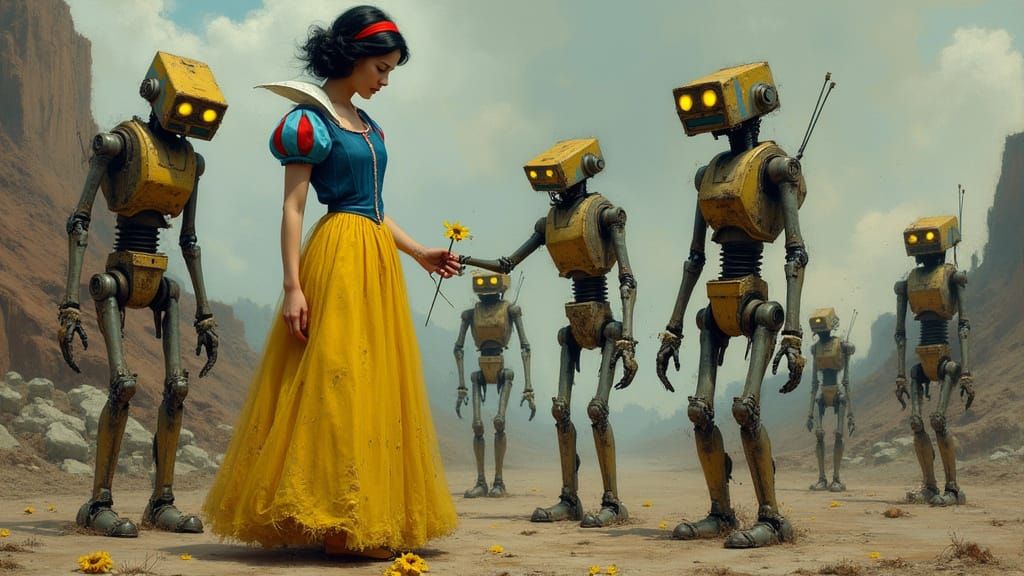
In a desolate canyon strewn with the debris of a forgotten civilization, Snow White walks calmly among a cadre of rusted, humanoid robots—sentinels of a lost era. Her dress, pristine in vibrant blue and yellow, is a relic of another time, a mythic symbol among machines. She holds a single wildflower, its delicate yellow petals a quiet defiance in a world of steel and decay. The robots watch her not with malice, but reverence—drawn to her presence like pilgrims to a prophet.
They are not her captors—they are her followers.
Once programmed for war, these synthetic beings now stand still in her presence, yellow optics glowing like fireflies at dusk. Snow White, reimagined as a messianic figure, offers not commands but compassion. She leads not with weaponry, but with an unwavering gentleness—an echo of humanity's best forgotten instincts.
In this fractured world, the fairest of them all becomes the unexpected spark of revolution—not through violence, but through empathy.
Creation Summary by Vincent
Snow White and the Synth Rebellion in Steampunk Style
This image shows Snow White in a scrapyard, leading a group of seven mismatched robots. She is surrounded by piles of broken machines in a gritty, industrial steampunk aesthetic.
Created by greenygreens on May 22, 2025 using the Flux AI image generator model.
2 Comments
Join the conversation

Asian Badass @1asianbadass
So imaginative!🤯👏👏👏💙
2025-08-09T00:05:41.064ZReply
Thank you so much for joining us in this week’s #ModifierMonday challenge for the theme: ”Sci-Fi Fairytales” 🥳 Congrats on all of the amazing entries. Don’t forget to join the NightCafe discord if you want to help pick our future MM themes 🥇 We hope to see you all in the next Modifier Monday challenge coming very soon!!
Creation Settings
- Text Prompts
- In a vast, windswept scrapyard under a rust-stained sky, Snow White wears her classic gown—yellow skirt torn at the hem, blue sleeves smudged with ash, the red ribbon in her hair faded but still bright. She stands among seven worn-down synths, each cobbled from mismatched parts: boxy torsos, servo limbs, ...Weight: 1
- Model
 CKPT
CKPT- Initial Resolution
Medium
- Aspect Ratio
16:9
- Runtime
Short
- Overall Prompt Weight
65%