
✨ Save 50% on Annual Plans ✨ Claim 6 months FREE →
Generate your own ancient wonders with AI
Create your own wonders of the ancient world. It's free and easy with our AI image generator!
2 years ago
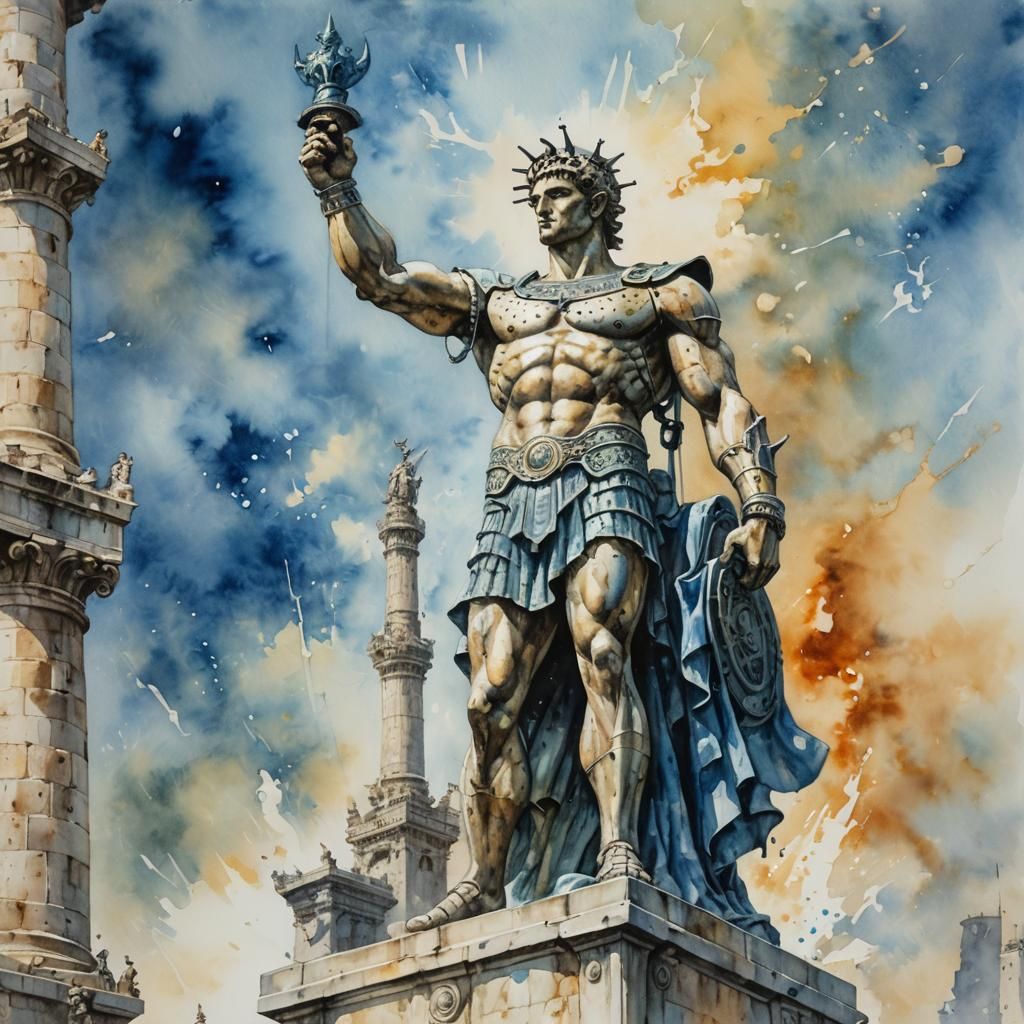
The Colossus of Rhodes, the sixth wonder of antiquity
Created 2 years ago · 14 comments· 0 likes
Dreamshaper XL Lightning
In the 3rd century BC, the Rhodians built a colossal bronze statue of the god Helios to commemorate his victory against Antigonus I, king of Macedonia.
Antigonus succeeded Alexander Magnus and tried to conquer the city, since it was an ally of Ptolemy I.
This colossal tribute to the Sun god towered the height of 30 to 33 meters. Its sheer size was such that, as Pliny described, 'few men can embrace its thumb, and its fingers are larger than many entire statues.'
Sadly, an earthquake demolished it in 226 BC. Although the king of Egypt, Ptolemy III Eurgetes, offered a lot of money and workers to raise it again, the Rhodians did not dare due to an oracle that advised against it.
Lying on the ground and revealing its very complex interior, the enormous remains of the giant, broken at the knees, were on display for 900 years until de Bronce was sold by Caliph Muawiya when he took Rhodes in 654.
14 Comments
Join the conversation

[deleted]
[Deleted]
2025-01-07T12:58:58.028ZReply

great work everyone hope to see you in the next challenge where it will be a different pantheon of deities to choose from.
First, you could have mentioned whose creation you evolved. Second, you could have asked first.

Oh wow! I love this image and the history lesson! ❤️ I was just talking about the Colossus of Rhodes today and how much I would love to visit Greece one day! 💫


Love these history lessons and your creations too 🤗
Creation Settings
- Text Prompts
The_Historian has hidden the prompt
- Model
- Initial Resolution
Medium
- Aspect Ratio
1:1
- Runtime
Short
- Overall Prompt Weight
50%