
All the best AI models in one place
Nano Banana, GPT Image, Flux, Seedream, Seedance and more. Try it now for free!

2 years ago
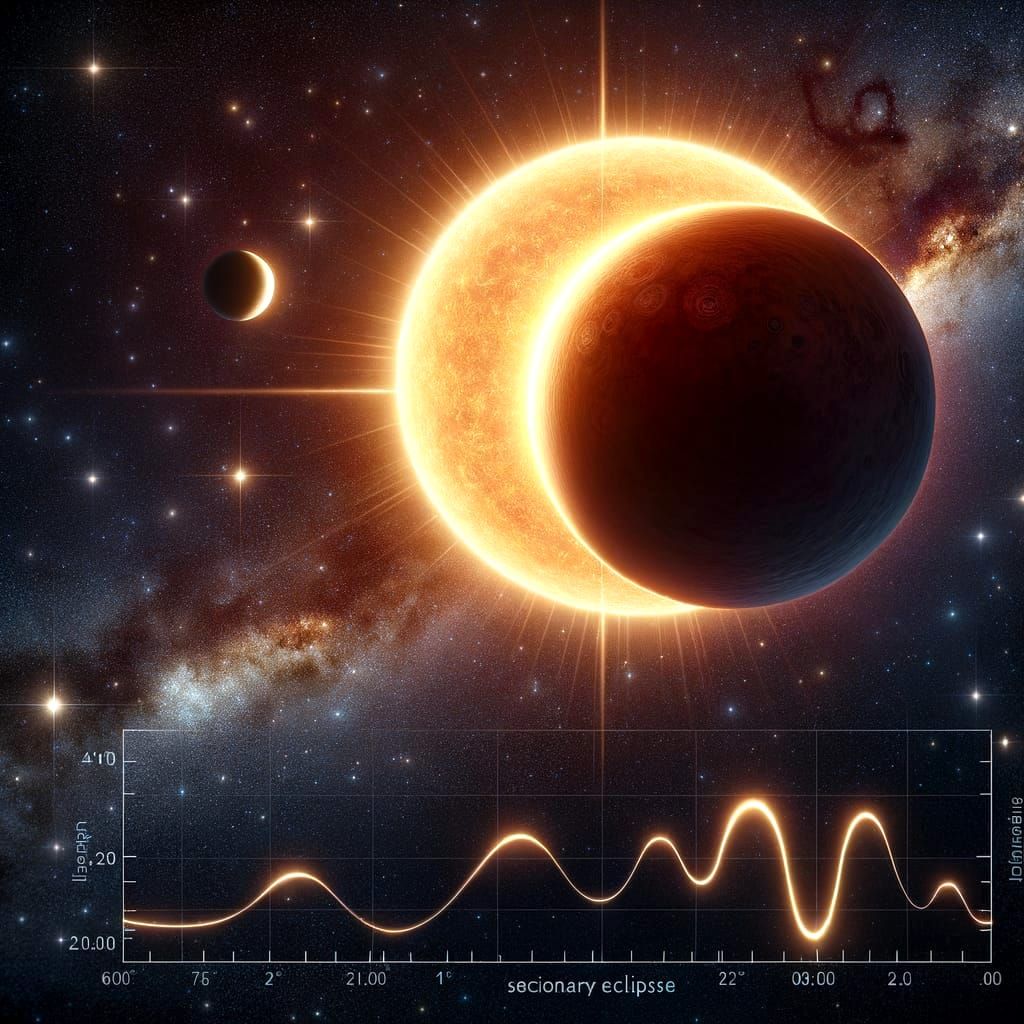
The Eclipse Method (Secondary Eclipse Method)
Created 2 years ago · 2 comments· 0 likes
 DALL-E 3
The Eclipse Method (also called the Secondary Eclipse Method) is a technique used to study exoplanets by observing how their light changes when they pass behind their star.
How It Works:
Normally, we see both the star’s light and the faint glow of the exoplanet (from reflected starlight or its own heat).
When the exoplanet moves behind the star (a secondary eclipse), the total brightness drops slightly because the planet's light is temporarily blocked.
By comparing the light before and during the eclipse, scientists can isolate the planet’s contribution, allowing them to analyze its temperature, atmosphere, and composition.
2 Comments
Join the conversation


Math Girl @Mathgrl
Has to be a fairly large planet with a relatively dense atmosphere that transits its star in the right orientation to us, but the thought that spectroscopic analysis of light passing through that sliver of gasses can tell us what's in the atmosphere gives me full body shivers! What's your opinion of "standard candles"?
2025-02-10T04:07:26.438ZReply
Creation Settings
- Text Prompts
Jade has hidden the prompt
- Model
 CKPT
CKPT- Initial Resolution
Medium
- Aspect Ratio
1:1
- DALL·E 3 Quality
High
- DALL·E 3 Style
Vivid


